SEARCH
Categories
Tags
Links
Archives
- September 2015
- July 2013
- May 2013
- September 2011
- January 2011
- December 2010
- November 2010
- September 2010
- August 2010
- July 2010
- May 2010
- April 2010
- March 2010
- December 2009
- November 2009
- October 2009
- September 2009
- August 2009
- June 2009
- May 2009
- April 2009
- March 2009
- February 2009
- January 2009
- December 2008
- November 2008
Razzle
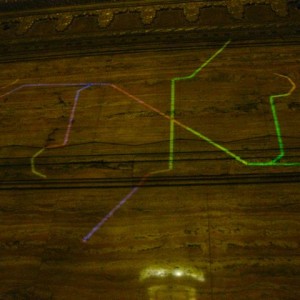
“Turtle” visuals at Mindshare LA
Sunday, September 19th, 2010I developed some new animations for September Mindshare at the old Stock Exchange in downtown LA, including “Turtle”– an experiment with creating complex structures by expanding on the concept of Turtle graphics. The left and right turn angles are variables and each turtle path is rotated and drawn multiple times to create rotational symmetry. Once [...]
Keep Reading » Comments Off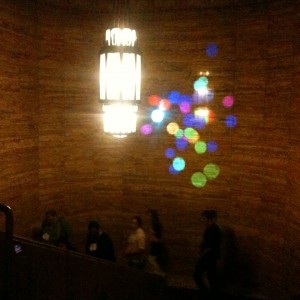
Visuals in the former LA Stock Exchange
Tuesday, September 14th, 2010The August edition of Mindshare was at the former Pacific Stock Exchange building in downtown Los Angeles. The building was built in 1929 and has great brown stone walls throughout. We were initially unsure of the effect of projecting onto this surface but the results were great. The colorful abstract shapes were imbued with a [...]
Keep Reading » Comments Off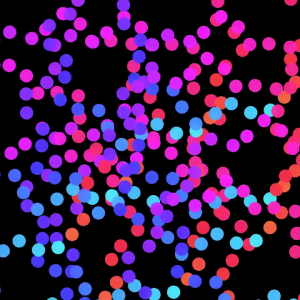
Razzle redux: now with automation
Friday, August 20th, 2010I recently dug up and improved Razzle, my custom-made VJ / performance program that I worked on at MAT last year. I added an automation feature that cycles through each animation every few minutes, and tweaks the animation parameters every few seconds, ensuring a constantly evolving display. The results were exhibited at August MindshareLA (pictures [...]
Keep Reading » Comments OffVideos at EwE
Tuesday, June 9th, 2009I was fortunate to have two videos featured in the demo reel for Everybody Wants Everything, the 2009 End-of-year show for Media Arts & Technology. In addition to the reel of generative colloquium intros I also showed an excerpt from an audio-visual collaboration with Aaron McLeran entitled “Pulse.” The video comes from the results of [...]
Keep Reading » Comments OffMAT Colloquium Video Intro
Thursday, May 21st, 2009I collaborated with Aaron McLeran, a fellow MAT student, to produce a series of introductory videos for our department’s colloquium series when they are posted online. Both the music and the visuals are generated on the fly and different every time. Below is a sampling of some of the takes: Media Arts & Technology Colloquium [...]
Keep Reading » Comments OffAnimation stills uploaded to Flickr
Friday, May 15th, 2009I have acquired a Flickr account to efficiently display large amounts of images from my projects. My goal is to show the wide variety of images that are feasible with the program I am writing as well as making it easy to trace the evolution of the program as new features are added and animations [...]
Keep Reading » Comments Off